
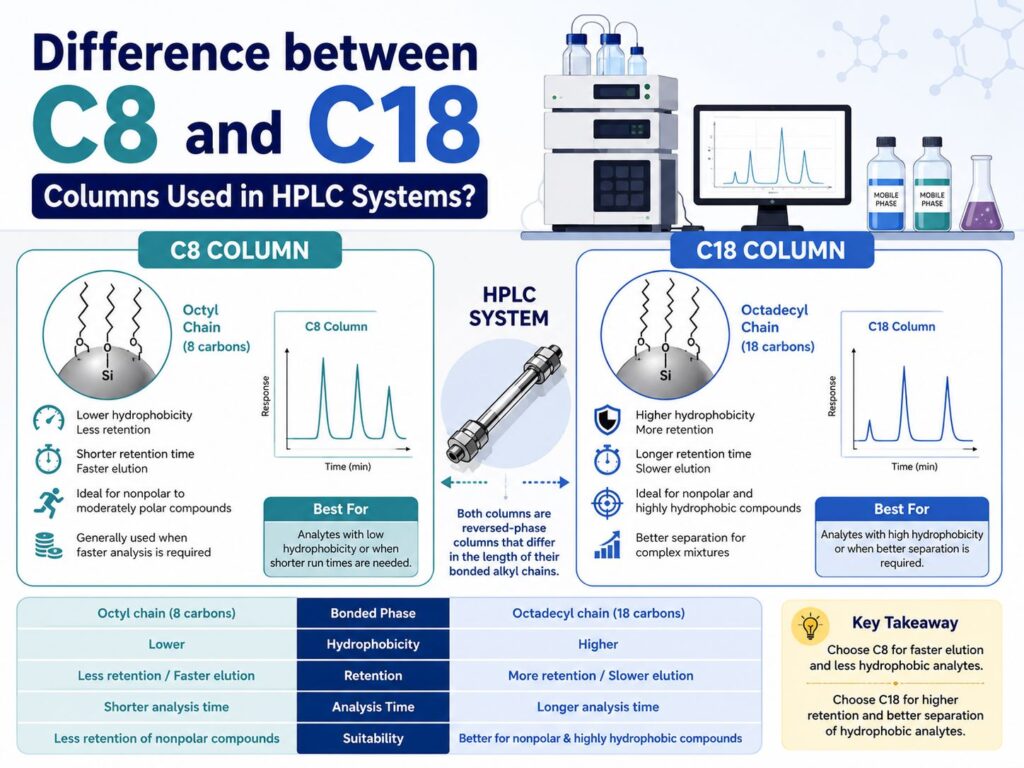
C8 and C18 are both types of columns used in pharmaceutical analysis, but their use is specific to the analysis of different products. Here we are discussing the difference between C18 and C8.
High-Performance Liquid Chromatography (HPLC) refers to an analytical chemistry technique used to identify, separate, and quantify each component in a mixture. C8 and C18 refer to the alkyl chain bonded to the surface of the chromatographic column. Both are widely used in HPLC.
The two columns share some similarities but also differ in several important ways. Some of the differences between C18 and C8 are discussed below.
- Octadecylsilane (C18) contains 18 carbon atoms bonded to the silica (Si) surface.
- Octylsilane (C8) contains 8 carbon atoms bonded to the silica (Si) surface.
C18 columns tend to retain compounds longer than C8 columns. If the same compound is analyzed on both columns, it will generally elute faster on a C8 column and slower on a C18 column.
This difference is due to the surface bonding density of the stationary phase. C18 has a denser bonded phase than C8, providing a larger hydrophobic surface area. This increases the interaction time between analytes and the stationary phase, resulting in better separation of more complex molecules.
In other words, C18 columns contain longer octadecyl chains, which are highly hydrophobic and therefore provide stronger retention of nonpolar compounds due to their longer carbon chain.
On the contrary, C8 has Octyl chains, and hence it is less retentive than C18 when the same compound is analyzed.
When short retention time is required, C8 is generally preferred. Its lower hydrophobicity allows nonpolar compounds to elute faster. Therefore, nonpolar compounds travel through the column more rapidly with C8 than with C18.
Column Specifications
Example Specification:
C18, 4.6 × 250 mm, 5 µm, 300 Å
Where:
- C18 → Bonded phase
- 4.6 × 250 mm → Column dimensions (Internal Diameter × Length)
- 5 µm → Particle size
- 300 Å → Pore size
Applications of C18 HPLC Columns
C18 HPLC columns are extensively used in:
- Environmental science
- Pharmaceutical industries
- Radioanalytical laboratories
- Chemical analysis
They are commonly used to analyze individual components of chemical mixtures and radiolabeled molecules.
Advantages of C18
- Better suited for separating long-chain fatty acids compared to relatively small organic compounds.
- Manufactured in large quantities, making them relatively cost-effective.
- Provide stronger retention and better separation for hydrophobic analytes.
Conclusion
C8 and C18 columns share many similarities. However, extensive research has identified several key differences between them. The choice between a C8 and a C18 column depends on the compound being analyzed, the desired retention time, and the separation performance required.