
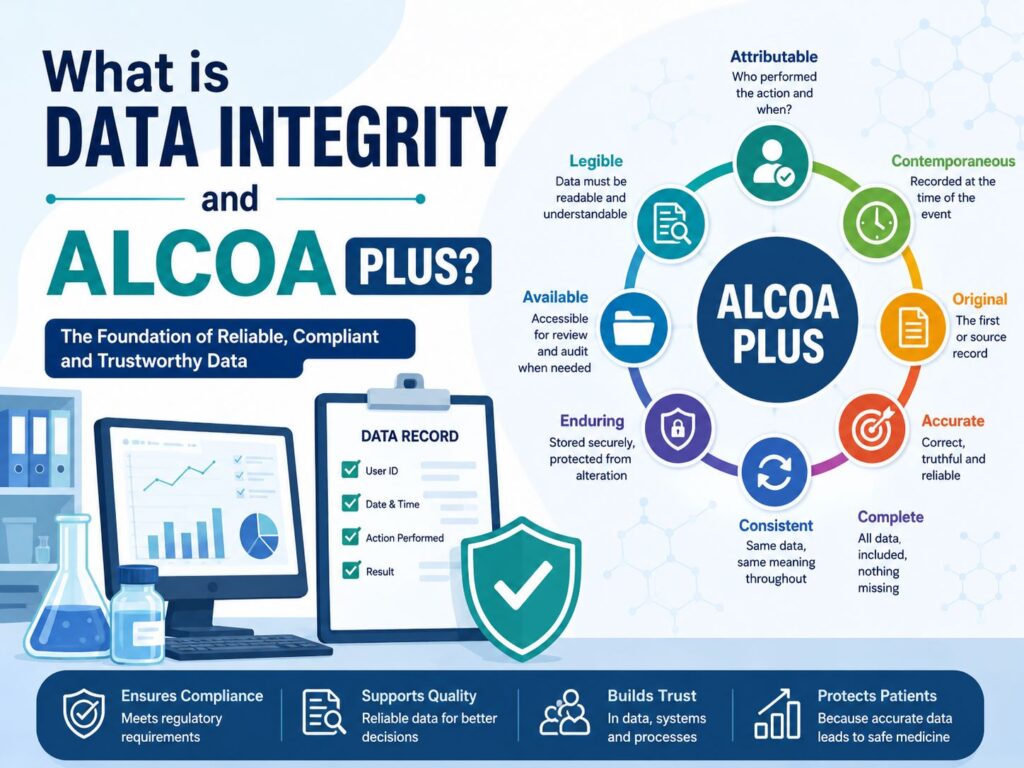
Data integrity is key in a pharmaceutical quality system ensuring that products are of the desired quality. Data Integrity is increasingly becoming a critical GMP issue in the Pharmaceutical and Medical Device Industry. ALCOA-plus is a commonly used acronym for Attributable, Legible, Contemporaneous, Original, and Accurate.
The descriptor ALCOA has been around since the 1990s and is used by regulated industries as a framework for guaranteeing data integrity and Good Documentation Practice (GDP). Originally, the ALCOA descriptor was introduced as a straightforward and practical guide by Stan Woollen of the U.S. Food and Drug Administration (FDA). It addresses FDA expectations relating to the integrity of paper-based, electronic, and hybrid quality system records. Today, it is considered a GMP requirement that every employee be trained in ALCOA and Data Integrity to promote a corporate culture that values data integrity.
ALCOA+ (Data Integrity Principles)
ALCOA
- A – Attributable
- L – Legible
- C – Contemporaneous
- O – Original
- A – Accurate
ALCOA+ Additional Principles
- Complete
- Consistent
- Enduring
- Available
These principles ensure that data generated in regulated industries (such as pharmaceuticals, medical devices, and biotechnology) is trustworthy, reliable, and compliant with GMP and regulatory requirements.
| Term | Definition |
|---|---|
| Attributable | Who acquired the data or performed an action, and when? |
| Legible | Can you read the data and any entries? |
| Contemporaneous | Data are recorded at the time they are generated or observed. |
| Original | A written printout, observed record, or certified copy thereof. |
| Accurate | Data are correct, truthful, complete, valid, and reliable. |
The Newer ALCOA Plus Adds a Few Additional Attributes
| Term | Definition |
|---|---|
| Complete | All data, including any repeat or reanalysis performed on the sample, are included. Nothing has been deleted. (Evidence: Audit Trail). |
| Consistent | All elements of the analysis, such as the sequence of events, follow the expected order and are date- or time-stamped accordingly. |
| Enduring | Data should not be recorded on temporary media such as envelopes, cigarette packets, sticky notes, or coat sleeves. They should be documented in notebooks or electronic data systems. |
| Available | Data can be accessed for review, audit, or inspection throughout the record’s retention period. |
Why Has Data Integrity Become a Hot Topic?
Inspectors from regulatory agencies have found instances where pharmaceutical manufacturing data were inaccurate or manipulated. Medicines are approved only when they are produced within declared specifications. If inspectors determine that the supporting data have been altered or are unreliable, the drug may not receive approval, leading to revenue loss for manufacturers and reduced availability of medicines for patients.
Beginning in 2014, there was a marked increase in warning letters issued to Indian drug manufacturers regarding data integrity, after the U.S. Food and Drug Administration (FDA) identified widespread issues during regulatory inspections.