
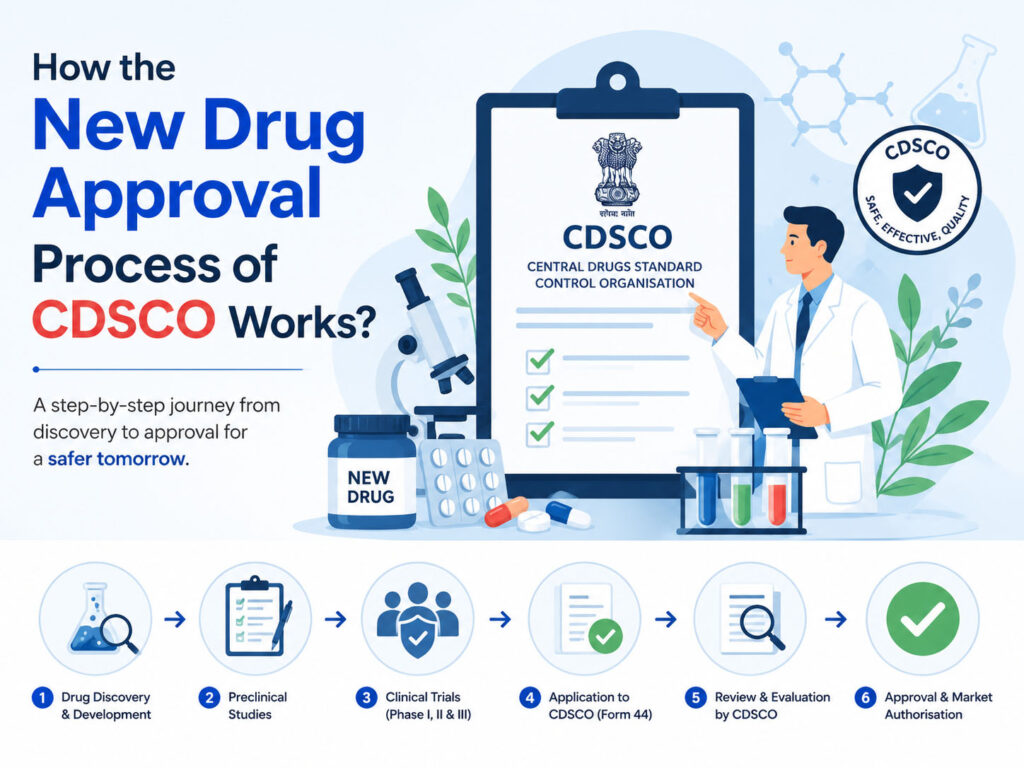
The process of approval of a new drug in India is a very intricate process, which should meet the necessary requirements. The new drug is a medication or therapy that has not been used earlier in clinical practice to treat a disease. A new drug that is marketed after the approval from the FDA. Getting new drug approval from the FDA is a multi-step process that takes years & money also. Here I am discussing the process of new drug approval in India.
When a company in India wants to manufacture/import a new drug, it has to apply to seek permission from the licensing authority (DCGI) by filing Form 44 (Form 44 – Application for grant of permission to import or manufacture a new drug or to undertake clinical trial) and also submitting the data as given in Schedule Y of the Drugs and Cosmetics Act, 1940 and Rules, 1945.
In order to prove its efficacy and safety in the Indian population, it has to conduct clinical trials in accordance with the rules specified in Schedule Y and submit the report of such clinical trials in the specified format.
However, Rule 122A (Application for permission to import a new drug) of the Drugs and Cosmetics Act, 1940 and Rules, 1945 states that the licensing authority may waive certain trials if it considers that, in the interest of public health, permission may be granted based on the information from clinical trials conducted in other countries.
Similarly, another provision in Rule 122A states that clinical trials may be waived for new drugs that have already been approved and have been used for several years in other countries.
Section 2.4(a) of Schedule Y
Section 2.4(a) of Schedule Y of the Drugs and Cosmetics Act, 1940 and Rules, 1945 states that for drug substances discovered in India, all phases of clinical trials are required.
Section 2.4(b) of Schedule Y
Section 2.4(b) of Schedule Y of the Drugs and Cosmetics Act, 1940 and Rules, 1945 states that for drug substances discovered in countries other than India, the applicant should submit the available data from those countries. The licensing authority may require the applicant to repeat all the studies or may permit the applicant to proceed directly from Phase III clinical trials.
Section 2.8 of Schedule Y of Drugs and Cosmetics Act 1940 and Rules 1945 says that the licensing authority might need pharmacokinetic studies (Bio-equivalence studies) initially to indicate that the data generated in the Indian population is adequate to data generated abroad and then require him to proceed with Phase III trials. In summary, the exact requirements of clinical trials may change from case to case and depend on the extent to which the licensing authority is satisfied with its safety and efficacy.
Bio-availability and Bio-equivalence studies are needed by regulations to confirm therapeutic equivalence between a pharmaceutical equivalent test product and a reference product. For bio-availability / bio-equivalence studies Application in Form-44, Application in Form-12, Undertaking by the Principal Investigator (PI), Regulatory status of the Drug in India indicating strength and dosage, BA/BE Center approval copy issued by DCG (I), New Delhi, along with details of number of beds provided at the center (CRO), Sponsor’s Authorization letter, the study protocols, study synopsis, Informed Consent Form (ICF) or Patient Info Sheet (PIS) together with audio-visual recording system as per Schedule Y guidelines & copy of approval of protocol from the IEC, Copy of registration of Independent / Institutional Ethics Committee (IEC) under Rule-122DD, Package insert / prescribing information of the product, Published reports of Pharmacokinetic and Pharmacodynamics studies carried out in healthy subjects / patients demonstrating safety and tolerability of the molecule and undertaking letter from the sponsor for complete compensation on any untoward condition are basically required for getting Drugs Controller permission.
In recent times, CDSCO has banned many unsafe and irrational Fixed drug combinations formulations in India. Court cases and trial cases are undergoing for several such formulations by giant pharmaceutical companies since 2016.